Heritage
Four generations have maintained the practice above the Quai du Mont-Blanc. Each has learned the craft from the previous, adapted it to their time, and passed it forward.
1928
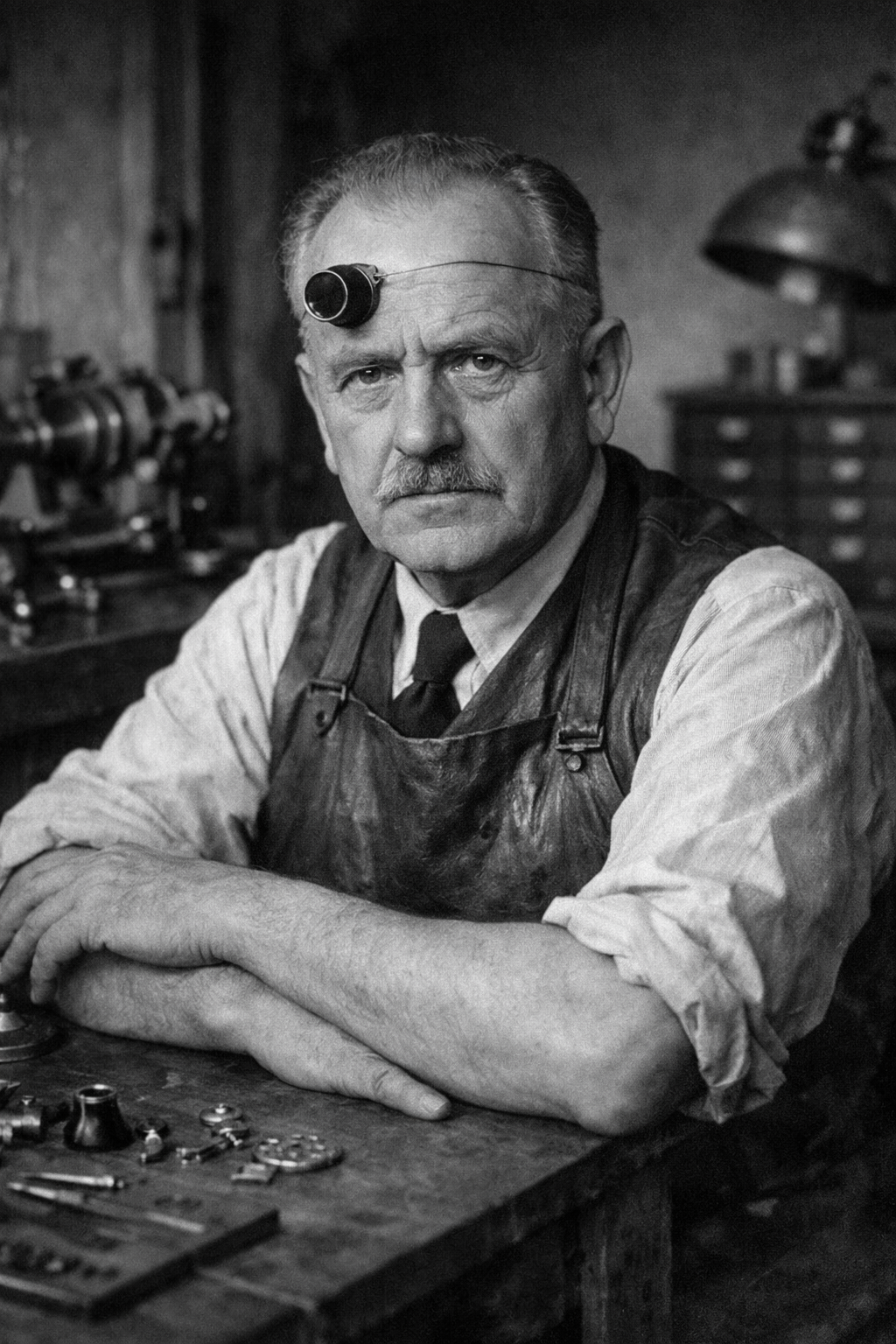
Émile Lavanchy
Émile established the atelier in a two-room workshop above the Quai du Mont-Blanc. He had trained at Vacheron Constantin for seven years, learning the traditional methods of Geneva's grande horlogerie. When the stock market collapsed in 1929, collectors began bringing their pieces to independent craftsmen who could work without the overhead of the great manufactures.
His specialty was the restoration of pocket watch complications — minute repeaters, chronographs, astronomical displays. He worked alone, taking on perhaps twenty pieces each year, establishing the practice of meticulous documentation that still guides the house today.
Representative piece:
Vacheron Constantin pocket watch, calibre 1003, restored 1934. Minute repeater with perpetual calendar, the movement completely rebuilt after water damage.
1961
Pierre Lavanchy
Pierre took over the workshop as wristwatches displaced pocket watches in collectors' interests. He expanded the practice to include sports watches — early Omegas, Rolexes, Patek Philippe Calatravas. The 1960s brought a new challenge: synthetic lubricants and electronic timing equipment that required different approaches to restoration.
He acquired the Schaublin lathe still used today and began fabricating replacement parts in-house. Pierre established relationships with parts suppliers across Switzerland and developed the archive system that allows the current generation to find components for movements manufactured decades ago.
Representative piece:
Patek Philippe Calatrava ref. 96, calibre 12-600, restored 1975. Complete movement overhaul with fabricated balance staff, regulated to chronometer standards.
1989
Antoine Lavanchy
Antoine guided the house through the quartz crisis, when many believed mechanical watchmaking would disappear entirely. He focused the practice on museum-quality restorations, working with private collectors and institutions to preserve timepieces of historical significance. The decision to limit production to twelve pieces annually was made during his tenure.
He modernised the workshop's equipment while maintaining traditional hand skills, acquiring the electronic timegrapher and ultrasonic cleaning systems still in use. Antoine established the house's policy of complete documentation, photographing every stage of restoration to create a permanent record of each piece's treatment.
Representative piece:
Omega Speedmaster Professional ref. 105.012, calibre 321, restored 2001. NASA-issued example worn on Apollo 15, complete restoration maintaining historical authenticity.
2019
Margaux & Léo Lavanchy
The fourth generation continues the practice as a partnership. Margaux specialises in case restoration and refinishing, having studied goldsmithing before returning to the family craft. Léo focuses on movement restoration, particularly the complicated calibres that require the deepest understanding of horological principles.
Together they have refined the house's approach to match contemporary collecting interests while respecting the standards established by their predecessors. They work with major auction houses to restore significant pieces before sale and maintain relationships with private collectors worldwide.
Representative piece:
Patek Philippe ref. 1518, calibre 89, restored 2023. Perpetual calendar chronograph, complete movement restoration with case refinishing, one of thirty-six examples known.
The fourth generation is still here.
The fifth has not yet decided.