Restoration
Seven stages that honour the maker's intent while respecting the passage of time. Each restoration follows this sequence, adapted to the particular needs of the piece.
RECEIPT
Initial assessment and documentation
Each piece arrives with its own history written in scratches, patina, and the particular way it has learned to keep time. We photograph every surface, document every mark, test basic functions. The movement is examined under magnification to identify its calibre, its manufacturer's intentions, and the modifications or repairs it has received over its working life.
We prepare a detailed condition report and restoration proposal. This becomes the contract between collector and atelier — what will be preserved, what must be renewed, what cannot be saved. No work begins until this proposal is approved.
DISASSEMBLY
Complete teardown and cataloguing
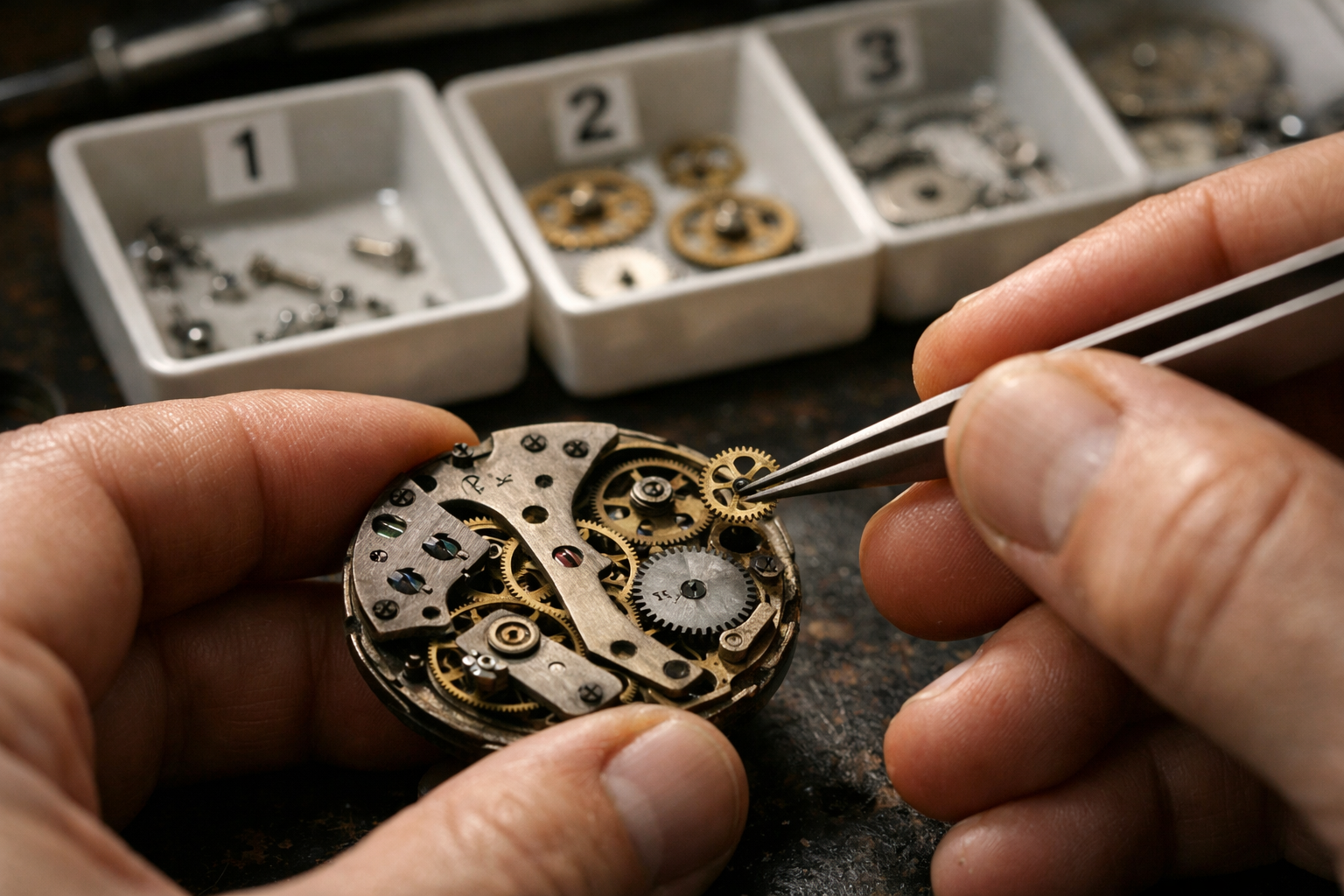
The movement is stripped to its smallest components. Each wheel, screw, and spring is photographed in position, then removed and placed in a numbered tray. We work systematically — bridge by bridge, train by train — creating a visual map of reassembly. The mainspring is wound down carefully; the balance wheel lifted with tweezers that have never touched steel.
Case and dial receive the same methodical treatment. Hands are pulled with proper tools. The dial feet are noted for their particular positioning. Every gasket, every washer, every spacer is preserved or marked for replacement.
EVALUATION
Component inspection and testing
Under the microscope, each component reveals its condition. Pivots are measured for wear. Gear teeth are examined for damage. The mainspring is tested for its ability to store power evenly. Jewels are checked for cracks or chips that would compromise their function. We determine what can be restored, what must be replaced, and what replacement parts we have in our archive.
This stage often involves research into the specific calibre's construction and the manufacturer's parts specifications. We consult technical manuals from the original factory, when they exist. Some components require fabrication using traditional methods.
PARTS
Sourcing and fabrication
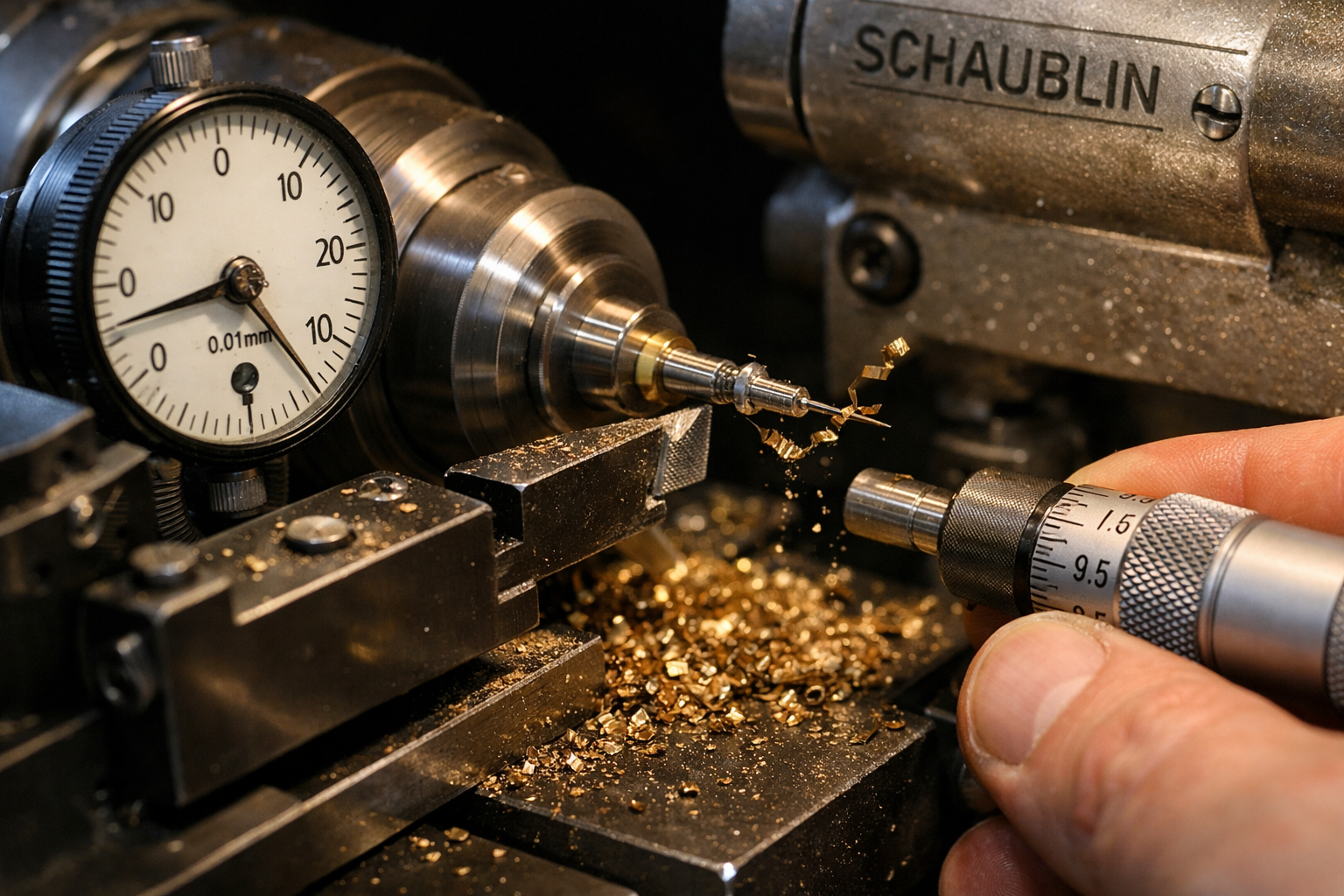
Replacement parts come from three sources: our archive of original components salvaged from donor movements, new-old-stock parts acquired over decades, and components we fabricate in the workshop. The lathe turns new balance staffs. The filing block shapes new bridge screws. Hairsprings are sourced from the few remaining suppliers who understand their metallurgy.
When possible, we prefer restoration over replacement. A worn pivot can be built up and repolished. A damaged wheel tooth can be reformed. The goal is to preserve the movement's original character while ensuring its mechanical integrity.
RESTORATION
Cleaning, refinishing, and repair
Components are cleaned in ultrasonic baths with solutions chosen for each material. Steel parts receive one treatment, brass another, jewels a third. Surfaces are refinished to their original specification — Geneva stripes on bridges, circular graining on wheel faces, mirror polish on steel components. The work is done by hand with traditional tools and techniques.
Case restoration follows similar principles. Scratches are polished out with progressively finer compounds. Dents are raised from the inside when possible. Original brushed or polished finishes are restored to match the manufacturer's intent. Gold plating is renewed where necessary, always to the original thickness and colour.
RECASING
Movement assembly and installation
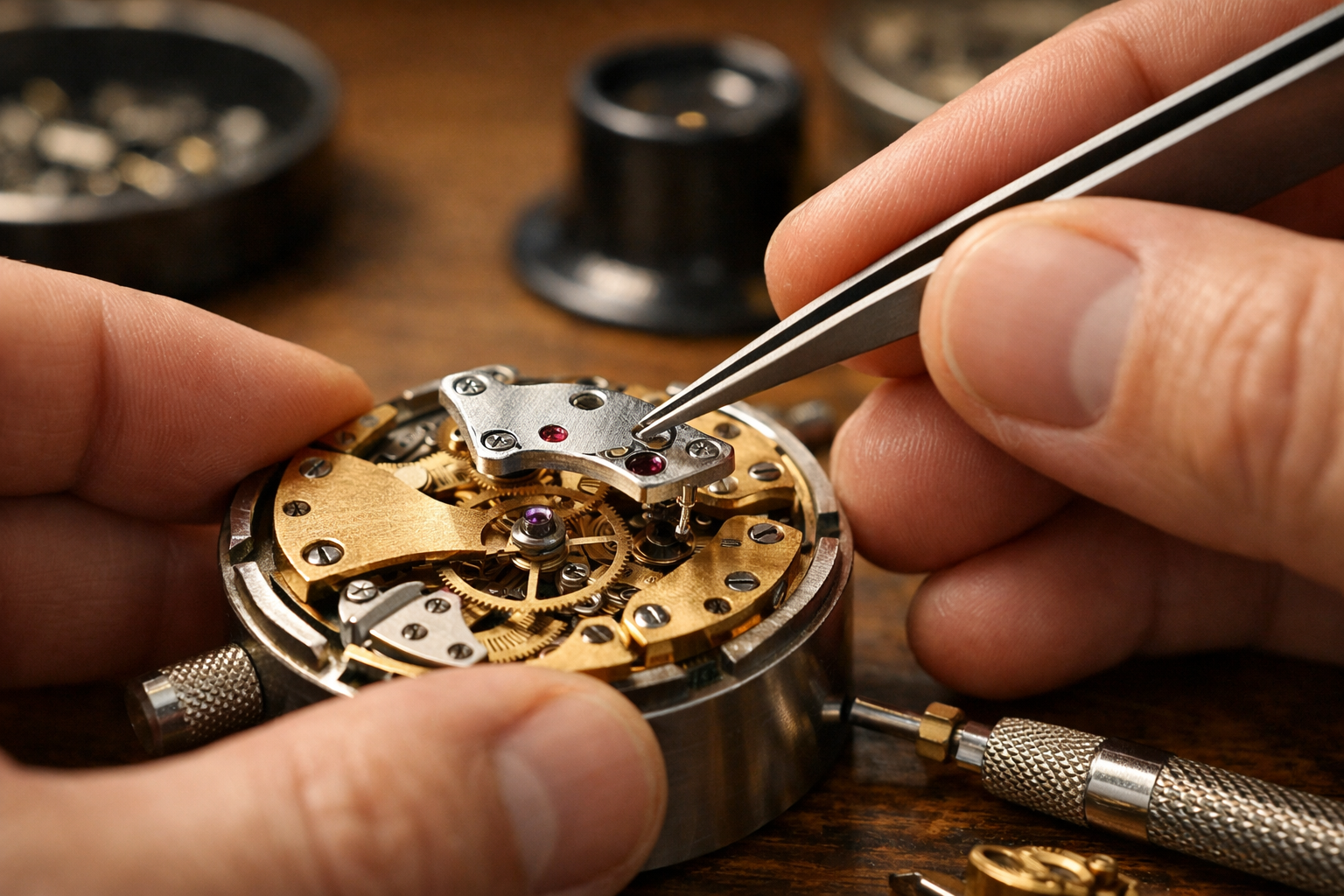
Reassembly follows the reverse sequence of disassembly, but with greater care. Each component is lubricated with the appropriate oil or grease for its function and position. The mainspring is wound into its barrel with steady tension. Jewels are oiled with microscopic precision. The balance wheel is poised to ensure even oscillation.
The completed movement is fitted to its case with new gaskets and seals. The dial is positioned exactly as originally intended. Hands are fitted and aligned. The crown and pushers are tested for proper function. Water resistance is restored where originally specified.
REGULATION & DELIVERY
Final timing and quality assurance
The final stage is regulation — teaching the movement to keep accurate time. This process requires patience and precision. The watch runs for days while its rate is monitored in different positions. The regulator is adjusted in tiny increments until the movement achieves the timing standards it maintained when first manufactured.
A complete restoration typically requires six to nine months from receipt to delivery. Each piece receives a certificate documenting the work performed and the standards achieved. We provide a two-year warranty on our restoration work. The watch is returned to its owner in a condition that honours both its heritage and its maker's original intent.